Popular Posts

Tuesday, October 18, 2011

Cambodia

Cambodia: Travelogues, Trip Journals, and Tourist Information

Phnom Penh, 1991 Cambodia is unforgettable. Don't go if you cannot stand to witness suffering. Don't miss it if you want the experience of a lifetime.
For better or worse, Cambodia is like no other nation on Earth. It is not an easy trip to make, but it has a power that few places hold: if you keep your eyes open, when you return from Cambodia, nothing anywhere will ever look the same.
What is it like? The articles below describe several different trips to Cambodia over the last 15 years:
A brief glimpse of a trip through Asia in an earlier time is available in a collection of postcards from 1966 and 1967:
Visitors with an interest in Khmer culture should try to include Cambodia's National Museum in their itinerary.
If you are planning to travel to Cambodia, you might want to take a look at medical recommendations for travel in Cambodia. This article was written in 1992, but most of the information is still relevant.
Oudong Elsewhere on the web, there are several excellent sites devoted to Cambodia. Links to some of the best are listed below. These sites will open in a new window.
  • Andy Brouwer's Cambodia Tales
    Andy Brouwer's "Cambodia Tales" is one of the oldest Cambodia travel sites on the web, and it's arguably the best. It includes an excellent, extensive collection of links to travelogues and trip journals, many photos, and discussion forums. Highly recommended.
  • Peter M. Geiser's Internet Travel Guide: Cambodia
    Another excellent site that has been around for ages; it ranks alongside Andy Brouwer's as one of the best Cambodia travel sites.
  • About Asia Travel
    A nicely-designed site devoted to travel in Asia.
  • Lonely Planet: Cambodia
    From the publishers of the renowned low-budget traveler's guidebooks, an all-around excellent site on Cambodia.
  • Rich Garella's Cambodia Travel Tips
    Rich Garella was formerly an editor at the Cambodia Daily. Few journalists know more about modern Cambodia, and his travel tips are worth heeding.
  • Crazy Guy on a Bike
    Excerpt: "Have you ever had a Camry driving at you, miss you by a foot going a 120 kph? It doesn't make for a good morning. And out here that is happening a couple of times a minute for two hours. And the road turns into dirt and it's the same dust as everywhere. I'm covered in dirt and had to stop a few times to wash my eyes out. And this road goes on forever. I just want it to end. I just want back into Thailand. And then a Cambodian lady on the back of a motorbike will turn look at you and smile, and it almost makes up for all the misery, almost."
  • Phileas Fogg: Cambodia 2004
    A handsome site, with outstanding photos.
  • Ian Cremona
    A well-done travel site, with excellent photos from Cambodia.
  • The Royal Embassy of Cambodia
    The official site of the Cambodian Government's U.S. embassy.
  • Centers for Disease Control Traveler's Health Area
    Information on medical conditions in any region of the globe, plus info on disease outbreaks, health tips for traveling with children, and much more. Look at this site before you travel to any foreign country.
  • Oanda.Com Currency Converter
    Need to know how many riels to one dollar? How many baht, or dong? Find out here.
  • Ninety Days in Cambodia by Marcel Stoessel
    A very informative and evocative article on the author's 1998 trip to Cambodia.
  • The Remaining Right Side of the Buddha by Gregg Butensky
    Handsome design, striking photos, and beautiful writing: travel sites do not get any better than this. Based on the author's experiences in Cambodia in 1993, this trip journal is compelling and fascinating.
  • Shawn and Yasuko's Southeast Asian Adventures
    A nicely detailed journal describing the authors' trip through Southeast Asia, including Cambodia.
  • Thailand and Cambodia 2000: Doug Burnett
    A very well-written journal describing the author's trip to Thailand and Cambodia. There aren't any photos, but it scarcely matters: the writer's vivid descriptions bring his trip to life.
  • Mike Meaney on the Net: Travel Diary, Cambodia and Vietnam
    A well-designed site distinguished by absolutely terrific photos.
  • Scuba Nation Diving Center, Cambodia
    Scuba diving instruction and tours, with offices in Sihanoukville (Kompong Som) and Sihanoukville.
  • Travelhog Travelogues
    This site is loads of fun: it's a fascinating and exhaustive collection of links to travelogues all over the web. This site is well-organized and definitely worthwhile.
  • Oriental Tales
    An elegant, easy-to-navigate collection of travel articles from East Asia.
  • Around the World in 80 Clicks
    A handsome, well-designed site with photos and articles describing trips all around the world.
  • Popular Guest House
    A guest house in Siem Reap. Personally, I haven't been there yet, but a close friend tells me it's a good place to stay.

The Facts of Cambodia

Cambodia: Facts, Figures, and Statistics

Cambodia Maps

Geography:

Total Area: Approx. 69,900 sq. miles (181,035 sq. km.). This is slightly smaller than the state of Oklahoma.
Location: Southeast Asia; bordered by Thailand, Laos, Vietnam, and the Gulf of Thailand.
Population (2004 Estimate): 13,107,000
Capital: Phnom Penh
Largest Cities: Phnom Penh, Battambang, Sihanoukville (Kompong Som), Siem Reap, Kompong Cham, Kompong Thom
Largest Lake: Tonle Sap
Major Waterway: Mekong River
Mountain Ranges: Cardamom, Dangrek
Highest Point: Phnom Aoral, 5,948 feet
Climate: Tropical, with two seasons, Rainy (May through October) and Dry (October through May). Temperature rarely falls below 80 degrees Farenheit.
Land and Land Usage: Mostly low, flat plains, with some small mountains in the north and southwest. About three-fourths tropical forest; roughly one-fifth arable land. Bulk of remaining land is composed of sandy and infertile soil.
Wildlife: Animals found in Cambodia include monkeys, water buffalo, tigers, elephants, leopards, and crocodiles.

Health and Education:

Infant Mortality Rate: 95.1 deaths per 1000 live births
Life Epectancy at Birth: 57 years
Literacy: Approximately 67.3% (57% among females, 79.5% among males).(Source: Royal Government of Cambodia Census, 1998).
Water Access: CARE estimates that only 36% of the population has access to safe drinking water. The Cambodian government's 1998 census estimates 29% overall, with 60.3% of urban households and 23.7% or rural households having access to safe water.

Government:

Cambodia Flag Type: Cambodia is a Constitutional Monarchy. The government is headed by democratically elected Prime Minister; a National Assembly is composed of 120 representatives. The voting age is 18. The reigning monarch is King Norodom Sihamoni, but his duties are mainly ceremonial. The current Prime Minister is Hun Sen. The first democratically elected leader in recent times, Norodom Ranariddh, was overthrown in a coup staged by Hun Sen in July 1997. Hun Sen was subsequently elected Prime Minister in elections in July 1998, but the elections were severely flawed by a climate of violence and intimidation. Recently, the political situation has stabilized, but serious problems of corruption and impunity remain. Elections in 2003, though still far from perfect, were less violent than earlier polls. Hun Sen once again emerged victorious.
Economy:

Primary Occupation: Agriculture
Chief Products: Rice, rubber, wood and wood products, corn, garments, rubies
Monetary Unit: Riel
GNP Per Capita, 2002 $1970 US

Culture:

Ethnicity: Khmer (approx. 90%); Chinese (approx. 5%); Vietnamese (approx. 5%); small minorities of hill tribes, Chams, Burmese, and Thai
Religions: Theraveda Buddhism (95%); Islam; Christian; animism; atheism
Languages: Khmer (95%); some French, Vietnamese, Chinese, and English

Pol Pot in Cambodia 1975-1979

An attempt by Khmer Rouge leader Pol Pot to form a Communist peasant farming society resulted in the deaths of 25 percent of the country's population from starvation, overwork and executions.
Pol Pot was born in 1925 (as Saloth Sar) into a farming family in central Cambodia, which was then part of French Indochina. In 1949, at age 20, he traveled to Paris on a scholarship to study radio electronics but became absorbed in Marxism and neglected his studies. He lost his scholarship and returned to Cambodia in 1953 and joined the underground Communist movement. The following year, Cambodia achieved full independence from France and was then ruled by a royal monarchy.
Map & Photos
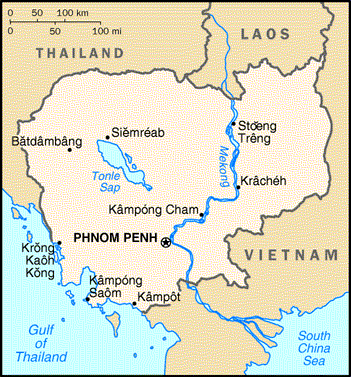
Cambodia and surrounding area.
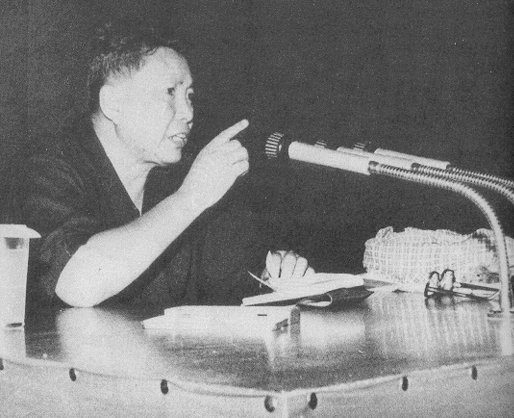
Pol Pot addresses a closed meeting in Phnom Penh after the 1975 Khmer Rouge victory.
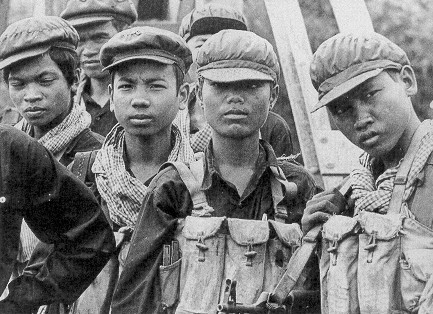
Young Khmer Rouge soldiers in 1975.
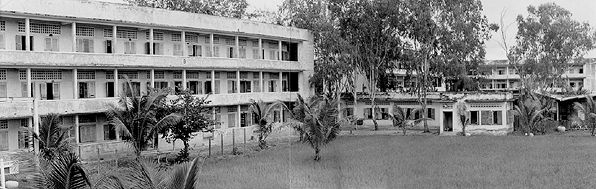
Tuol Sleng Prison, the nerve center of the Khmer Rouge secret police. Today it's the Tuol Sleng Museum of Genocide.
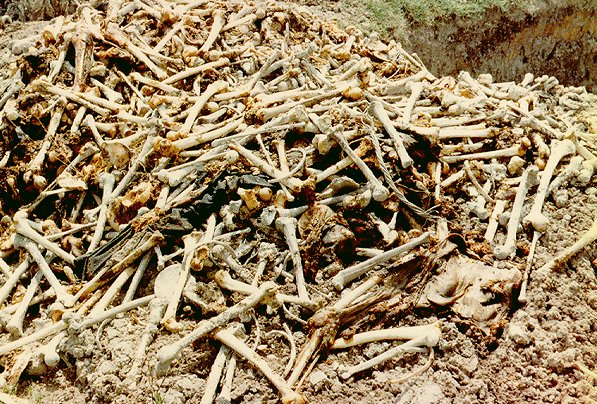
The Killing Fields at Choeung Ek. This mass grave, discovered in 1980, was one of the first proofs to the outside world of what had occurred during Pol Pot's regime.
By 1962, Pol Pot had become leader of the Cambodian Communist Party and was forced to flee into the jungle to escape the wrath of Prince Norodom Sihanouk, leader of Cambodia. In the jungle, Pol Pot formed an armed resistance movement that became known as the Khmer Rouge (Red Cambodians) and waged a guerrilla war against Sihanouk's government.
In 1970, Prince Sihanouk was ousted, not by Pol Pot, but due to a U.S.-backed right-wing military coup. An embittered Sihanouk retaliated by joining with Pol Pot, his former enemy, in opposing Cambodia's new military government. That same year, the U.S. invaded Cambodia to expel the North Vietnamese from their border encampments, but instead drove them deeper into Cambodia where they allied themselves with the Khmer Rouge.
From 1969 until 1973, the U.S. intermittently bombed North Vietnamese sanctuaries in eastern Cambodia, killing up to 150,000 Cambodian peasants. As a result, peasants fled the countryside by the hundreds of thousands and settled in Cambodia's capital city, Phnom Penh.
All of these events resulted in economic and military destabilization in Cambodia and a surge of popular support for Pol Pot.
By 1975, the U.S. had withdrawn its troops from Vietnam. Cambodia's government, plagued by corruption and incompetence, also lost its American military support. Taking advantage of the opportunity, Pol Pot's Khmer Rouge army, consisting of teenage peasant guerrillas, marched into Phnom Penh and on April 17 effectively seized control of Cambodia.
Once in power, Pol Pot began a radical experiment to create an agrarian utopia inspired in part by Mao Zedong's Cultural Revolution which he had witnessed first-hand during a visit to Communist China.
Mao's "Great Leap Forward" economic program included forced evacuations of Chinese cities and the purging of "class enemies." Pol Pot would now attempt his own "Super Great Leap Forward" in Cambodia, which he renamed the Democratic Republic of Kampuchea.
He began by declaring, "This is Year Zero," and that society was about to be "purified." Capitalism, Western culture, city life, religion, and all foreign influences were to be extinguished in favor of an extreme form of peasant Communism.
All foreigners were thus expelled, embassies closed, and any foreign economic or medical assistance was refused. The use of foreign languages was banned. Newspapers and television stations were shut down, radios and bicycles confiscated, and mail and telephone usage curtailed. Money was forbidden. All businesses were shuttered, religion banned, education halted, health care eliminated, and parental authority revoked. Thus Cambodia was sealed off from the outside world.
All of Cambodia's cities were then forcibly evacuated. At Phnom Penh, two million inhabitants were evacuated on foot into the countryside at gunpoint. As many as 20,000 died along the way.
Millions of Cambodians accustomed to city life were now forced into slave labor in Pol Pot's "killing fields" where they soon began dying from overwork, malnutrition and disease, on a diet of one tin of rice (180 grams) per person every two days.
Workdays in the fields began around 4 a.m. and lasted until 10 p.m., with only two rest periods allowed during the 18 hour day, all under the armed supervision of young Khmer Rouge soldiers eager to kill anyone for the slightest infraction. Starving people were forbidden to eat the fruits and rice they were harvesting. After the rice crop was harvested, Khmer Rouge trucks would arrive and confiscate the entire crop.
Ten to fifteen families lived together with a chairman at the head of each group. All work decisions were made by the armed supervisors with no participation from the workers who were told, "Whether you live or die is not of great significance." Every tenth day was a day of rest. There were also three days off during the Khmer New Year festival.
Throughout Cambodia, deadly purges were conducted to eliminate remnants of the "old society" - the educated, the wealthy, Buddhist monks, police, doctors, lawyers, teachers, and former government officials. Ex-soldiers were killed along with their wives and children. Anyone suspected of disloyalty to Pol Pot, including eventually many Khmer Rouge leaders, was shot or bludgeoned with an ax. "What is rotten must be removed," a Khmer Rouge slogan proclaimed.
In the villages, unsupervised gatherings of more than two persons were forbidden. Young people were taken from their parents and placed in communals. They were later married in collective ceremonies involving hundreds of often-unwilling couples.
Up to 20,000 persons were tortured into giving false confessions at Tuol Sleng, a school in Phnom Penh which had been converted into a jail. Elsewhere, suspects were often shot on the spot before any questioning.
Ethnic groups were attacked including the three largest minorities; the Vietnamese, Chinese, and Cham Muslims, along with twenty other smaller groups. Fifty percent of the estimated 425,000 Chinese living in Cambodia in 1975 perished. Khmer Rouge also forced Muslims to eat pork and shot those who refused.
On December 25, 1978, Vietnam launched a full-scale invasion of Cambodia seeking to end Khmer Rouge border attacks. On January 7, 1979, Phnom Penh fell and Pol Pot was deposed. The Vietnamese then installed a puppet government consisting of Khmer Rouge defectors.
Pol Pot retreated into Thailand with the remnants of his Khmer Rouge army and began a guerrilla war against a succession of Cambodian governments lasting over the next 17 years. After a series of internal power struggles in the 1990s, he finally lost control of the Khmer Rouge. In April 1998, 73-year-old Pol Pot died of an apparent heart attack following his arrest, before he could be brought to trial by an international tribunal for the events of 1975-79.

Recognizing Each Other


Recognizing Each Other
    Recognizing each other is a communication between people and people, animals and animals, and other living things. But sometimes people can recognize animals well, because they live with animals since they were kids. Now let’s read the paragraphs below.

The communication between males and females

Normally when we are adults, boys and girls usually communicate with each other. This factor shows that their appearances, feelings, and social psychologies. In society they should communicate with everybody (males and females). To make these relationships you should know what do your partners like, dislike, and their feelings. You can start to be active in class and society. You ought to join the members in community or attend the social works, because you can meet lots of people there. And you also can make relationships with them. You should remember that you don’t have to join the most popular group to make relationships. Please read the paragraphs below to get more information about making relationships:

                                           Chapter I.        Friendship


Friendship is the most important factor to make a successful relationship. Those communications will be able to last for long time including weddings also begin from these relationships.
Friendships will be able to last for long time if the partners to suitable behaviors, the same ideas and understand the value of each other. Every people who want to swindle the others can’t last their relationship for long time.

·        Speaking: you should talk to others pleasantly, cordially, and with smile face. These actions are a sign that you want to make a relationship. You ought to listen to others carefully and give the chance to them to talk. You shouldn’t admire yourself.
·        Acknowledging the others’ characteristic: everybody always has different characteristic. You shouldn’t mock or scorn others. The best way is you should understand their characteristic.
·        Esteeming one another: you should esteem with he/she first, before accepting someone to attend he/she to do something with you.
Friendship can begin with everybody who is surrounded you such as parents, siblings, classmates, neighborhoods...etc. Teenagers should know how to glorify unities and relations without discriminating. Friendship should be a relation with valuation, honestly, broadly, and confidence with each other. Friendship is a step that forward to a successful relation. These are 5 ways to make the communication step forward:
1.      Respecting: respecting others is a way to support the honor and valuation, and acknowledge the others’ characteristic.
2.      Responsibilities: everyone can assist you, you should do your duties with responsibilities and you should divide the mistakes, the best, and the worst clearly.
3.      Favoring: you should acknowledge others’ characteristic such as concepts, opinions, clothes, and feelings... That means your feelings should go along with the others’ feelings.
4.      Sacrifice: sometimes you have to abandon your authorities, moral forces, relationships for the advantages.
5.      Paying attention: you should worry and pay attention on the feelings and everything your partners need. It means if you love or like someone you must take care and surround him/her.
Friendship is the most important thing in our lives, especially teenagers. Depends on friendships many teenagers can understand and gather many experiences for their lives.

                           Chapter II.        Feelings and Loves


    Friendships between girls and boys begin with admiring each other and understanding each other. After that they will develop from friends to couples.
      Feelings’ snatching is the way to win the hearts for a short period of time. Normally, this feeling can be removed or sometimes we can make sweet relations.
      Love is affection, especially males and females. Love will develop from very small to a really big love when the couples understanding each other well.

                                          Chapter III.        Meeting

      Meeting starts with the communications between males and females. We meet in the purpose of understanding each other well. Meeting is a contract between two or several people to meet each other at somewhere and a definite time.
       First males and females can see each or recognize each other by attending the visions or other ceremonies such as parties and picnics. When they are falling in love with each other, they invite each other to other ceremonies. The partners can accept or refuse the invitations depends on the feelings. In this situation parents should examine and understand their meetings clearly when they are teenagers.
      Meeting with valuation and relations will have lots of advantages for their communications, because they can have chance to understand the person that they want to live with.
1.      Types of meeting
Meetings have three types:
a.      Group meetings:
It’s the first step of communications between males and females. They can organize many programs with many appearances such as competitions, journeys, visiting places, and parties...etc.
b.      Pair meetings:
This kind of meeting usually happens between males and females that have the same ages and that have that have almost the same favorites. This kind of meeting can also be another partner. This presence can console only the feelings for the first meetings.
c.      The meetings between two people:
This kind of meeting usually happens between a boy and a girl who agree to go out with each other. Teenagers must not meet each other (only two people). You should meet in group for discussions and having lots of great time with each other.
2.      The advantages of meetings
Meetings can give us a lot of advantages depend on different kind of meetings:
Meetings for happiness to have lots of great time with the person we love or like. The communications in society give the chances to teenagers to understand each other and glorify the attitudes in communicating and create the conversation with happiness.
Meetings give the chances to single people can establish friendship. Finally, they can choose their wives or husbands.
All of the memories and attitudes can build when the meeting is a step of understanding the feelings, engaging, and wedding. They also can know how to control their feelings.
3.      The attributes and attitudes in meetings
In the meetings you should apply these actions:
·        Tell the parents the place that you gotta go. Notice the definite time that you will return home.
·        You should invite you are going to go with to your home to introduce him/her to your family.
·        You shouldn’t spend your money too much. If you must spend your money for the meetings, you shouldn’t buy something that is too expensive.
·        You should return home on time.
·        You shouldn’t talk about bad things or say bad words.
·        If you don’t want to go out with someone, you should refuse it in polite way.
The Background of Study

Recognizing each other is the way to find friends and wives or husbands for everyone’s future. It’s the first step to begin a relationship and a happy family. And everyone can’t avoid from having families. Everybody has to cross these situations. But I think it’s great to have a family and being the owner of my own life. That’s also nice to be a wife or a husband and being a parent. Recognizing each other also gives us lots of advantages such as we can have a happy family...etc. For instance, before having a happy family, we should understand the feelings of each other before we get married. So, we can have a nice family. In fact, I also make a friendship by working in groups. It’s nice to be his friend and spending time with him. It’s the reason that I take this topic.